
What Did a Winter Survey Find in Saudi Arabia’s Managed Bee Colonies?
A winter survey of 11 commercial apiaries in southwestern Saudi Arabia found generally low levels of Nosema and several bee viruses. The results offer an early benchmark for tracking disease in managed Arabian honey bee colonies over time.
The full story
What Happened? [1]
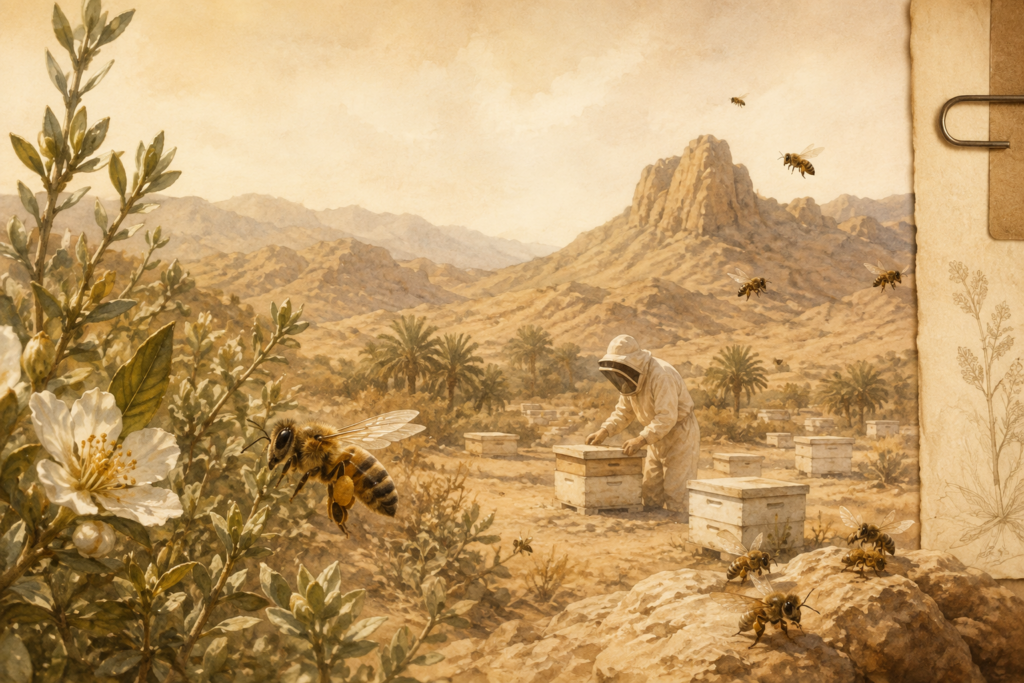
Researchers surveyed managed colonies of the Arabian honey bee, Apis mellifera jemenitica, at 11 commercial apiaries across southwestern Saudi Arabia. They looked for two Nosema microsporidia, seven honey bee-associated viruses, and Varroa destructor mites. [1]
They reported that Nosema-positive samples contained N. ceranae, not N. apis. The detected Nosema and virus levels varied among places but were generally low in this survey. The authors present these measurements as a regional baseline for future monitoring. [1]
Why Should We Care? [1]
Bee health is local as well as global: the kinds and amounts of pathogens found in a region can help beekeepers and researchers recognize future changes. This study provides molecular measurements from commercial colonies of A. m. jemenitica in southwestern Saudi Arabia, a population for which the authors say such pathogen-quantification data have been scarce. [1]
Its value is therefore mainly as a benchmark. Repeated surveys, including in other seasons and regions, could show whether these relatively limited detections remain stable or change over time. [1]
What Did the Researchers Find?
- The team sampled five colonies at each of 11 commercial apiaries in southwestern Saudi Arabia. [1]
- All Nosema-positive samples were identified as Nosema ceranae; Nosema apis was not detected. [1]
- Molecular testing detected Nosema DNA in some samples where microscopy did not observe spores, indicating greater sensitivity of the molecular assay in this survey. [1]
- Among seven viruses tested, Black Queen Cell Virus was detected at six locations, Deformed Wing Virus in two colonies, and Chronic Bee Paralysis Virus at trace levels in three colonies; the other four targeted viruses were not detected. [1]
- The authors also reported a mean Varroa destructor count of 2.02 mites per 100 adult bees across the sampled locations. [1]
How Do We Know? [1]
Workers were collected from managed colonies from late December 2022 to early February 2023. The researchers counted Nosema spores with microscopy, used PCR-based testing to identify Nosema species, and used quantitative PCR (qPCR) to measure Nosema DNA and viral genetic material. They also measured Varroa mites on adult bees. [1]
These methods can detect evidence of particular pathogens and estimate their levels in the sampled colonies. They do not, by themselves, show every effect those pathogens had on colony survival, honey production, or pollination. [1]
What Doesn’t This Study Prove?
A regional snapshot, not a national census The work covered 11 commercial apiaries in southwestern Saudi Arabia during one winter sampling period. It does not establish pathogen levels across all Saudi Arabian colonies, unmanaged bees, or every season. [1]
Detection is not the same as disease outcome Finding pathogen genetic material, spores, or mites does not prove that a pathogen caused poor colony performance, colony loss, or clinical disease in a particular colony. [1]
The study cannot prove innate disease tolerance The authors interpret the low detected pathogen levels as consistent with possible natural tolerance in A. m. jemenitica. But this observational survey did not experimentally compare genetic tolerance, survival, or resistance with other honey bee populations. [1]
Non-detection has limits A virus or Nosema species not detected by these tests in these samples was not demonstrated to be absent from the wider region or at other times; it may have been below the assay’s detection level or outside the sampled colonies. [1]
Where Did This Research Come From?
Research Record
- Original Study: Nosema ceranae and honey bee-associated virus levels in commercial beekeeping operations across Southwestern Saudi Arabia
- Authors: Keegan Nichols, Khalid A. Khan, Zubair Ahmad, Hamed A. Ghramh, Juliana Rangel
- Journal: Journal of Invertebrate Pathology
- Publisher: Elsevier BV
- Publication: 2026-05-03
- Honey Chronicles Timeline Date: Online ahead of print
- Online Publication Date: 2026-05-03
- Volume: 218
- Pages / Article: 108637
- Species Studied: Apis mellifera jemenitica
- DOI: 10.1016/j.jip.2026.108637
Sources Consulted
- Primary scholarly source: Nosema ceranae and honey bee-associated virus levels in commercial beekeeping operations across Southwestern Saudi Arabia
- ctaex.com
- www.sciencedirect.com
- www.researchgate.net
- ouci.dntb.gov.ua
- www.researchgate.net
- ouci.dntb.gov.ua
- www.researchgate.net
- www.researchgate.net
- www.sciencedirect.com