
Can Gold Nanorods Help Screen Honey for Heat and Storage Damage?
Researchers built arrays of tiny gold nanorods that strengthened Raman signals from 5-HMF, a compound that can rise with heating or poor storage. In prepared samples with added 5-HMF, the method showed promise as a screening tool.
The full story
What Happened? [1] [2]
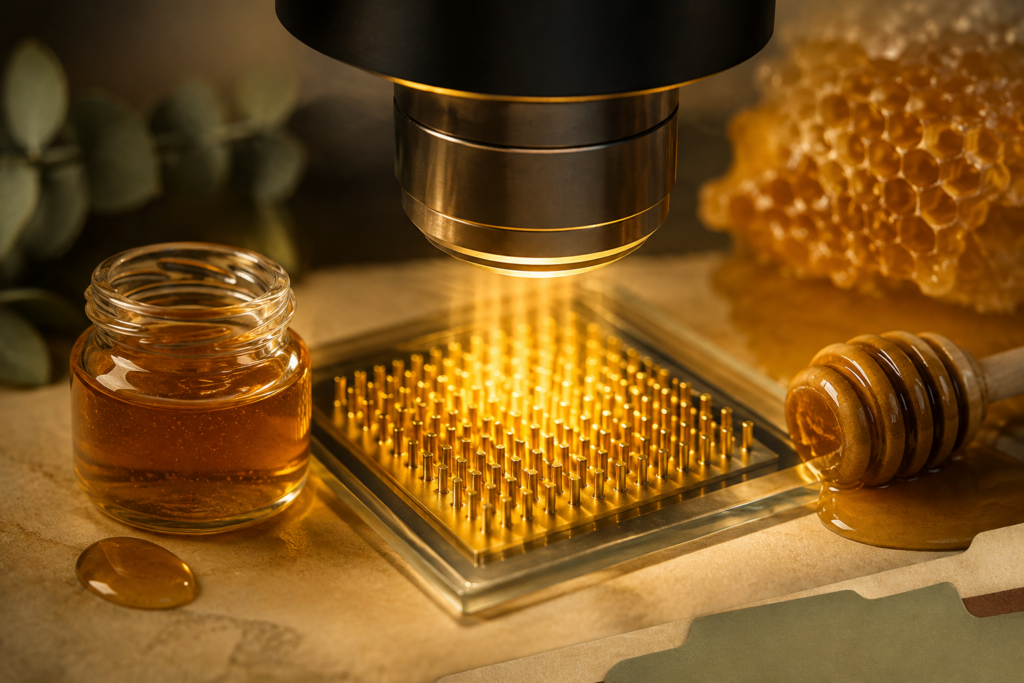
Researchers built ordered arrays of gold nanorods—tiny rod-shaped gold structures—as a surface-enhanced Raman spectroscopy (SERS) substrate for detecting 5-hydroxymethylfurfural (5-HMF) in honey. They adjusted the nanorods’ shape and assembled them at a three-phase interface to create closely spaced tips and gaps where Raman signals could become stronger. [1] [2]
The array with a nanorod aspect ratio of 3.5 gave the strongest signal under the study’s 785 nm laser. In honey samples spiked with known amounts of 5-HMF, the authors reported a detection limit of 35.4 mg/kg. [1] [2]
Why Should We Care? [1] [2]
5-HMF is a compound that can increase when honey is heated or stored under unfavorable conditions. Measuring it can therefore help assess honey handling and quality. [1] [2]
This study explores whether a carefully engineered SERS surface could support faster screening than laboratory methods that require more elaborate instruments and preparation. Its reported detection limit in spiked honey was below the 40 mg/kg threshold discussed by the authors. That makes the approach promising as a possible screening tool—but not yet a demonstrated replacement for established regulatory testing. [1] [2]
What Did the Researchers Find?
- The researchers made uniform gold-nanorod arrays using a three-phase interfacial self-assembly process. [1] [2]
- Among the tested arrays, nanorods with an aspect ratio of 3.5 produced the strongest SERS response; the authors linked this to a close match between a 781 nm plasmon-resonance wavelength and their 785 nm laser. [1] [2]
- For 5-HMF standards, signal intensity increased across the reported 1–50 mg/L concentration range, with a stated detection limit of 0.093 mg/L. [1] [2]
- The authors reported signal-uniformity and inter-batch reproducibility relative standard deviations of 3.86% and 2.51%, respectively. [1]
- In honey samples spiked with 5-HMF, the reported detection limit was 35.4 mg/kg and recoveries ranged from 73.32% to 95.92%. [1] [2]
How Do We Know? [1] [2]
The publisher’s article record and the PubMed record provide the study abstract and bibliographic details. The abstract describes the gold-nanorod design, the reported signal-performance measures, and trials using honey samples with added 5-HMF. [1] [2]
The findings are measurements reported by the authors. The proposed explanation—field concentration at nanorod tips and coupling across narrow gaps—is the researchers’ interpretation of how the array amplified the Raman signal. [1] [2]
What Doesn’t This Study Prove?
Spiked samples are not the same as a broad survey of marketplace honey. The accessible abstract reports tests in honey spiked with known 5-HMF amounts. This supports performance in those prepared samples, but does not by itself show how reliably the method works across many naturally variable honeys, floral sources, ages, or processing histories. [1] [2]
It does not establish a replacement for standard laboratory testing. The paper presents a promising SERS approach, but the accessible record does not verify a large independent comparison with reference methods such as validated chromatography across a broad set of real-world samples. [1] [2]
The study does not prove that 5-HMF alone tells the full story of honey quality or safety. The work focuses on measuring one compound. Honey quality, authenticity, storage history, and safety involve additional chemical, biological, and regulatory considerations not tested here. [1]
Some methodological detail remains unavailable for this draft. The publisher page was accessible through its indexed abstract and section excerpts, but full-text access was restricted during review. This draft therefore avoids unverified details such as the number and origin of honey samples, full validation design, and detailed statistical comparisons. [1] [2]
Where Did This Research Come From?
Research Record
- Original Study: Controllable self-assembled AuNRs array with dual signal amplification for SERS detection of 5-HMF in honey
- Authors: Jia Bin Zhang; Wan Hui Guo; Hao Zhang; Wen Pan; Ye Min Guo; Fan-Li Zhang; Cheng Wang; Sheng Hong Liu
- Journal: Spectrochimica Acta Part A: Molecular and Biomolecular Spectroscopy
- Publisher: Elsevier BV
- Publication: 2026-06-03
- Honey Chronicles Timeline Date: Preprint posted online (SSRN)
- Online Publication Date: 2026-06-03
- Journal Issue Date: 2026-12-05
- Volume: 362
- Pages / Article: 128156
- Research Location / Affiliations: China Jiliang University, Hangzhou, PR China; Xinjiang Uygur Autonomous Region Academy of Agricultural Sciences, Urumqi, PR China
- DOI: 10.1016/j.saa.2026.128156